Research
We want to know how genes are regulated. Most of all, we are drawn to what happens after transcription, when RNA-binding proteins settle what becomes of each mRNA. It is hard to watch, so we build the methods to see it: high-throughput biochemistry and sequencing that take in the whole transcriptome at once. Looking at every gene lets the data show us rules we did not know to look for. The rules for reading an mRNA are also the rules for writing one, and we use them to design mRNA vaccines and therapeutics.
Designing mRNA Medicines
A single protein can be written as more than 10600 different mRNA sequences, far more than there are atoms in the universe, because most amino acids have several synonymous codons. Only some of those sequences make a good medicine.
And a vaccine mRNA gets one chance. The cell keeps transcribing its own mRNAs, but the one we deliver cannot be replaced once it is gone, so how long it survives and how efficiently it is read decide how much protein it makes.
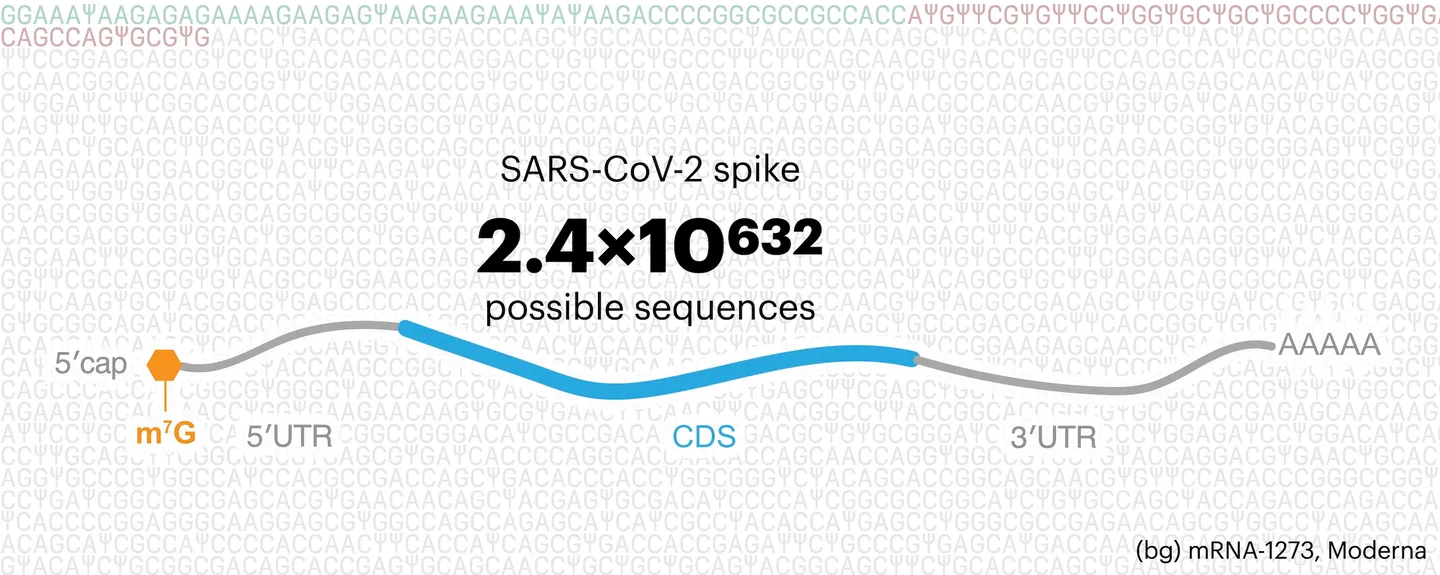
Finding the right sequence starts at the bench. We measure what really happens to mRNAs in cells, turn those measurements into the rules our algorithms follow, and send the sequences they design back to the bench to be tested.
Testing the rules. Design tools optimize features that are believed to matter. Which ones really do is still an open question. We answer it in cells, measuring thousands of sequence variants side by side to see what changes how long an mRNA lasts and how much protein it makes.
Design algorithms. The answers go into software that has to search that astronomical space well. It weighs every shape an RNA can fold into and protects the regulatory elements in the untranslated regions at either end. It is also fast: running on parallel cloud computers, it can keep pace with an outbreak response such as CEPI’s 100 Days Mission. Our open-source tool VaxPress and our newer design engine, Ribogami, work this way today. Next, GARFold moves RNA folding onto GPUs, and a differentiable version of the calculation lets us work backward from the structure we want to a sequence that forms it.
Beyond vaccines. Vaccines against infectious disease were just the first mRNA medicines. mRNA is now expanding into rare diseases and cancer, where it may replace a protein a patient’s body cannot make, teach the immune system to recognize a tumor, or turn a patient’s own T cells into CAR-T cells. Each of these asks something different of the sequence, and the difference can decide whether the medicine works. We are extending our methods to all of them and opening them to everyone, so that every lab making an mRNA medicine, large or small, can reach the best design there is.
Reading RNA, One Molecule at a Time
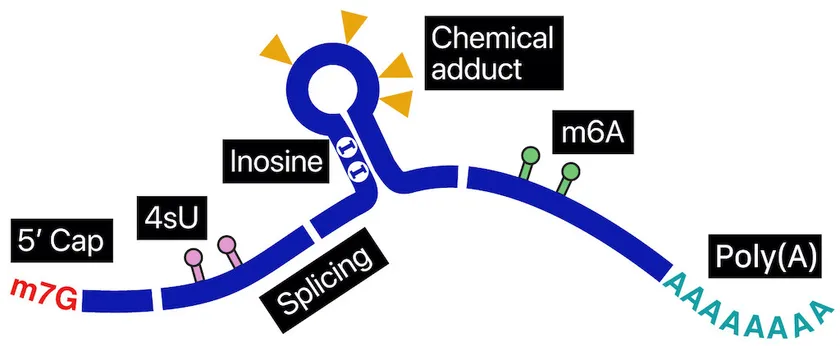
Every gene gives rise to many mRNA molecules, and no two need be alike. Each may be spliced differently, carry modified bases, end in a poly(A) tail of its own length, travel to a different part of the cell and be bound by a different set of proteins. Together these features decide how long a molecule lives and how much protein it makes. Most sequencing methods, though, read short fragments averaged over millions of molecules, so they cannot tell whether two features sit on the same molecule.
Nanopore direct RNA sequencing reads each molecule whole. As an RNA strand threads through a pore a few nanometers wide, every base that passes changes the current through the pore. The signal spells out the sequence, and modified bases and the poly(A) tail leave their own marks in it. The RNA is read as it is, without first being copied into DNA.
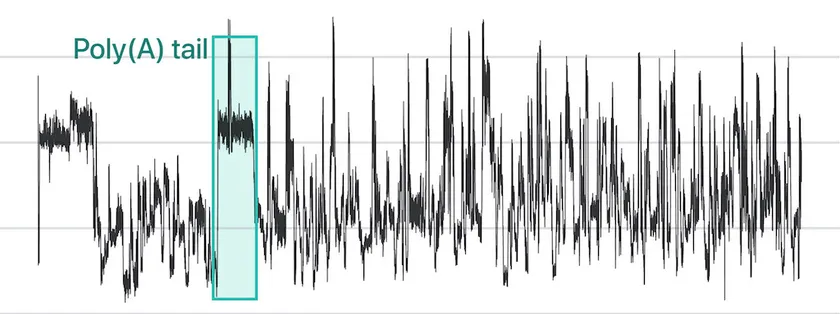
Proteins on RNA. Our main focus is the proteins bound to each RNA. We develop biochemical methods that mark where a protein sat on a molecule, so a single read shows every footprint on that RNA, and machine learning tools that find those marks in the raw signal. Over millions of molecules, the footprints add up to a transcriptome-wide landscape of how proteins assemble on RNA and which ones bind together.
A molecule’s history. The same molecules also tell us roughly when each was made, how busily it was translated and how long its tail was. With all of this we can follow how cells tune individual messages over time.